




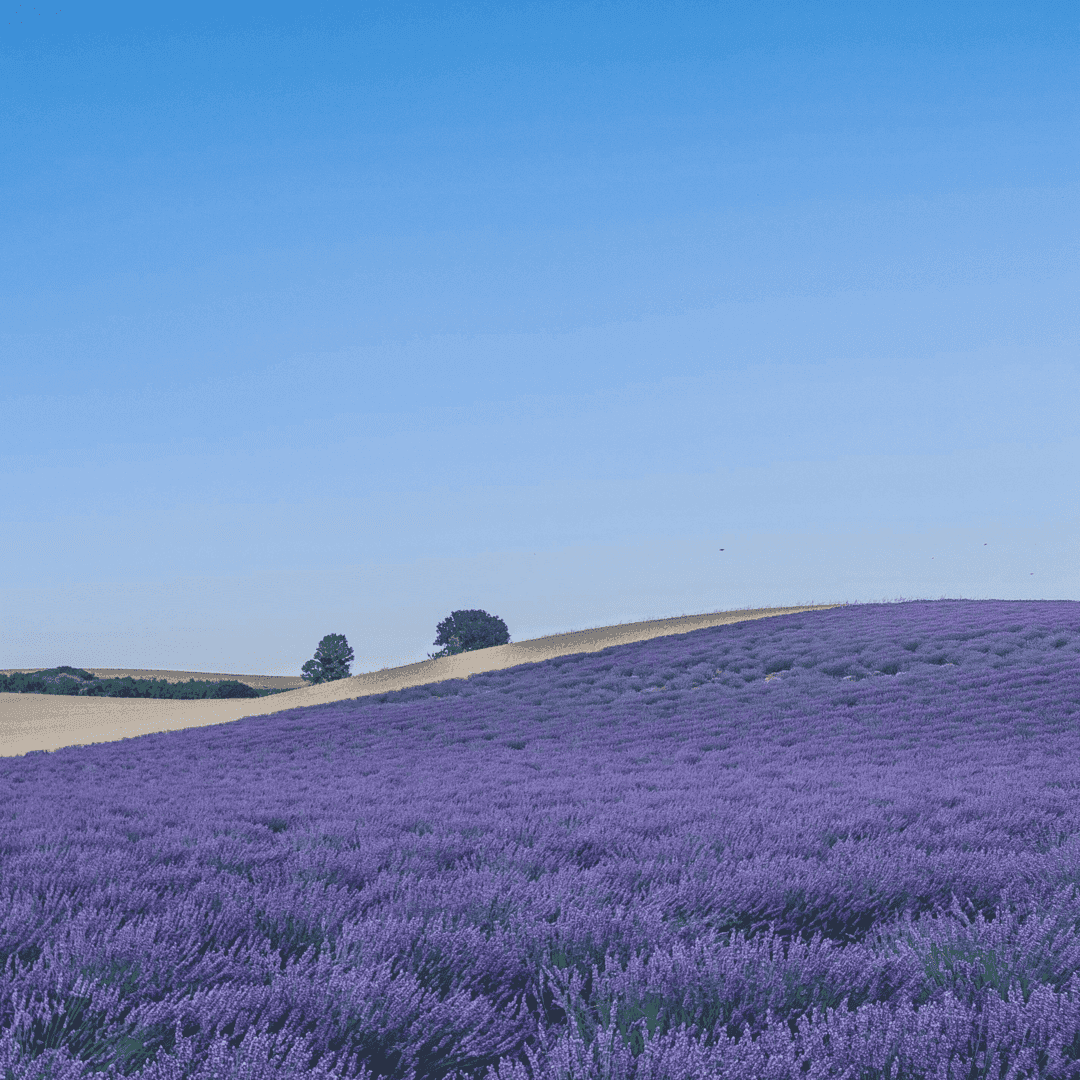
Many people are aware of the benefits of lavender essential oil.
We know it is used in the production of natural cosmetics, in candle making, and for aromatherapy.
But do you know how lavender essential oil is obtained?
“Distillation It is a process and method of separating a liquid mixture of chemical compounds by the physical process of evaporation, followed by condensation of the mixture’s components. It is used to isolate or purify one or more compounds present in the mixture.“
That’s right, lavender essential oil is obtained through the distillation of fresh lavender flowers.
In this text, we will try to give you a more detailed insight into how the entire process works.
Table of content
Lavender distillation process
If you have ever steamed some vegetables, you can probably understand how the distillation process is performed.
We often tend to look at a final product and admire its beauty, while neglecting the science, knowledge, and effort behind it.
To get a quality product, besides knowledge, a little creativity and skill is also needed.
For the distillation process, specific apparatus is required, which varies in size and dimensions depending on the amount of plant material needed for distillation, but the process is essentially the same.
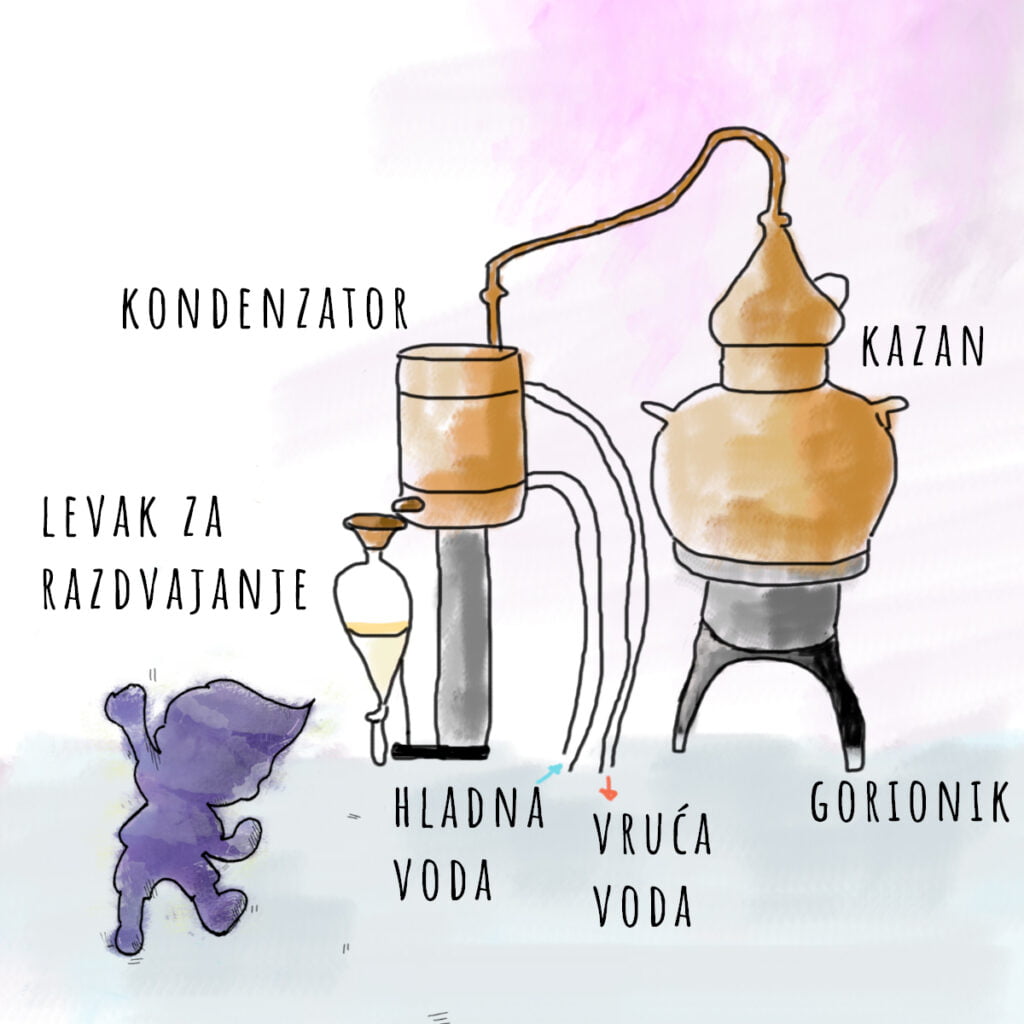
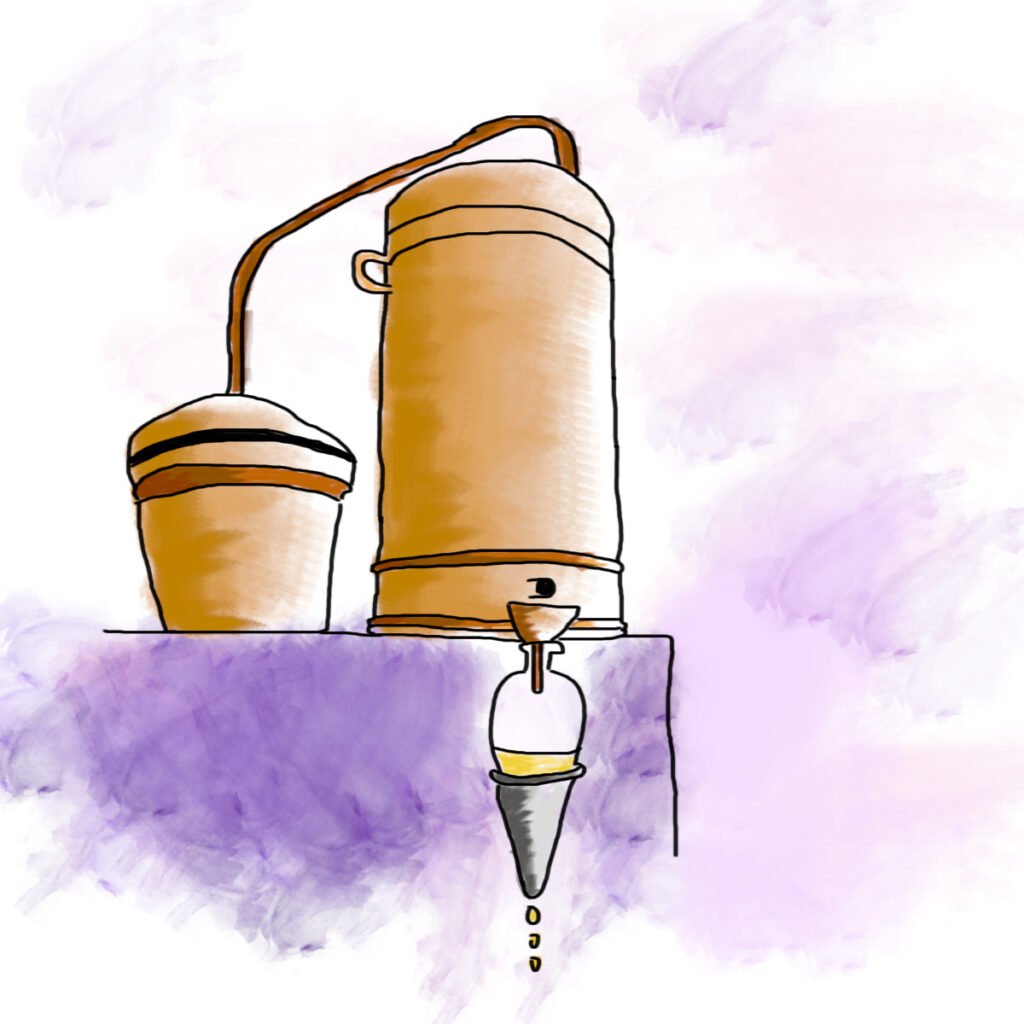
The basic apparatus required for performing distillation includes:
- Boiler
- Condenser
- Burner
- Cold water inlet
- Hot water outlet
- Funnel for separating the distillate
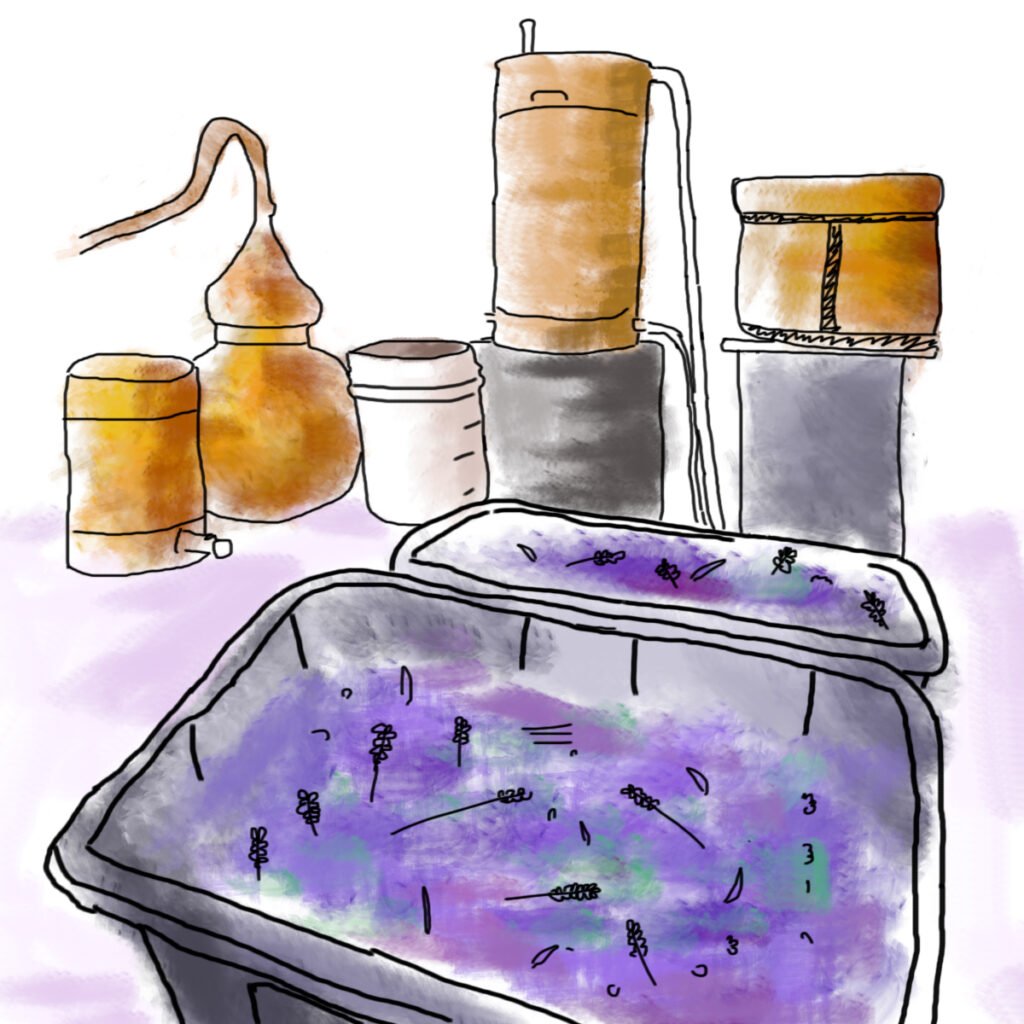
Preparation of the distillation process
Obtaining lavender oil takes place in a process called steam distillation.
Besides this method of distillation, there is also so-called water distillation. Steam distillation is much better than water distillation, because with water distillation reflux occurs, i.e. loss of essential oils in waste water. Therefore, water distillation should be used only if it is necessary, such as for distillation of delicate flowers, like rose flowers or if the plant material is in powder form (dried sandalwood).
Plant material in steam distillation does not come into contact with water, so this method of distillation is far more efficient and ensures a higher quality final product.
For the steam distillation process we need a boiler or some similar copper vessel. The upper partition inside the boiler, in which the plant material is located, needs to be adjusted to the appropriate height depending on the size of the boiler. In the case of a 300-liter boiler, the partition is adjusted to 25 cm from the bottom of the boiler.
After that, it is necessary to fill the boiler with water up to the partition with the plant material.
The lavender that will be used in the distillation process is placed above the partition, in this way it is ensured that the plant material does not touch the water or get damaged due to high temperatures.
How to fill the distillation boiler
Before setting up the entire distillation apparatus, lavender stems need to be cut and chopped, in order to extract the largest amount of essential oil from the plant material.
For a 60-liter boiler, 10 kilograms of fresh lavender is needed. For a 300-liter cauldron you will need 50 kilograms of plant material.
10 kilograms of fresh lavender flowers can be harvested from 6 to 12 lavender bushes depending on the variety and age.
Lavender for distillation is usually harvested at the end of the season, when it is at the end of full bloom. When the plant is in full bloom, then the most essential oil is present in the flower itself.
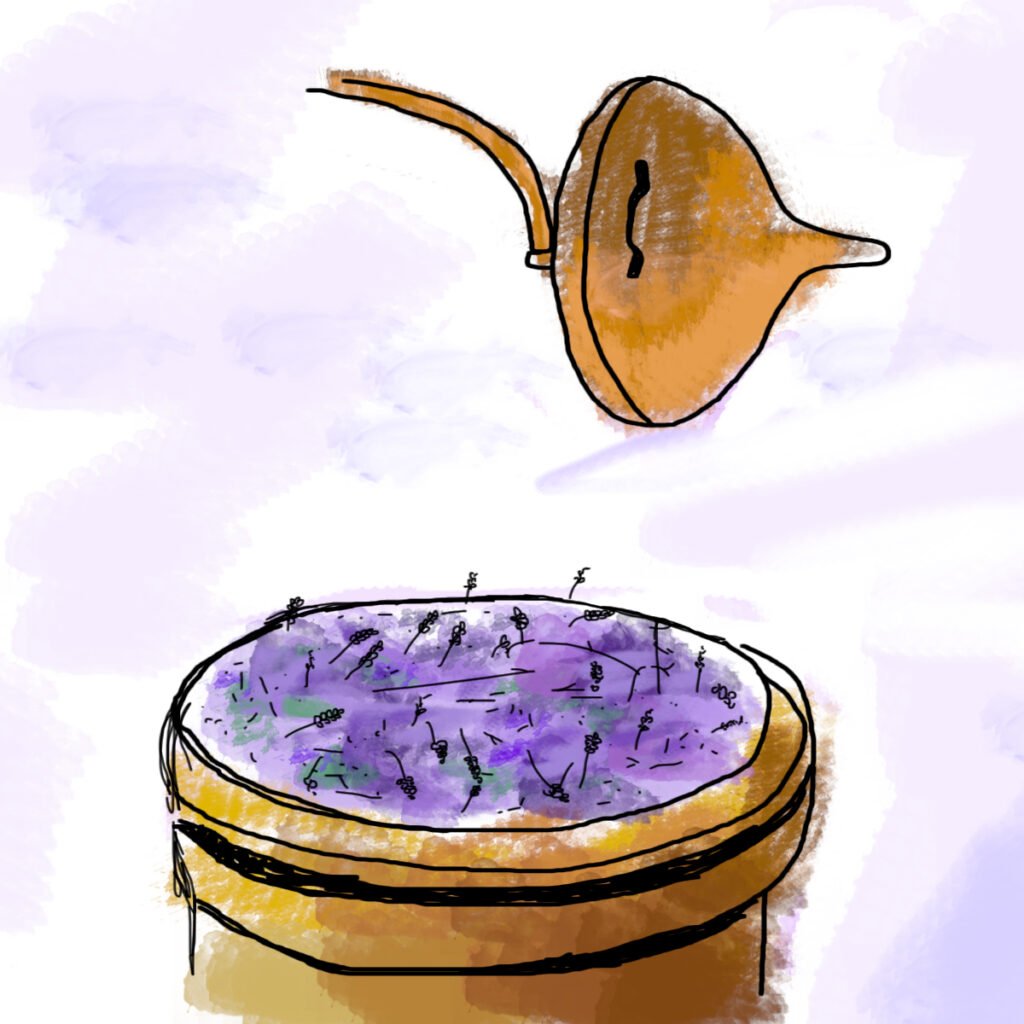
When filling the boiler with plant material, it is necessary to distribute and pack the raw material well and avoid the occurrence of "air pockets". When filling, lavender is placed in the space between the limiters to the top of the cauldron.
When the cauldron is properly filled, it is necessary to lower the lid and connect the cauldron to the condenser and slowly turn on the burner under the cauldron.
The magic begins.
Distillation process
This is the part when the entire magic unfolds before our eyes. Just like when vegetables are steamed, the whole essence of the distillation process is that by boiling water from the bottom of the boiler, water vapor is created that passes through the plant material that is in the boiler.
While water vapor passes through the lavender that is in the boiler, under the pressure that is created in the boiler, the plant material releases essential oil.
Did you know that there is a higher concentration of essential oil in lavender buds than in the flower itself?
Condensation
During the distillation process, the smaller vessel that connects to the boiler is called a condenser. The condenser is the part that contains a metal pipe through which water vapor passes that contains particles of essential oil. In the condenser, the water vapor is cooled.
The pipe inside the condenser is bent in such a way that it forms a coil, so that the water vapor can be cooled more efficiently and faster. It is important to note that the condenser is filled with cold water, which needs to be changed during the process.
In this way, water vapor that is in gaseous state, passing through the coil, transitions back to liquid state.
The water with which the condenser is filled, during the process gets heated, and thus we get hot water that is discharged through a valve at the top of the condenser.
The hot water is then replaced with cold water, so that the water vapor condensation process can continue uninterrupted.
After the water vapor returns to liquid state through condensation, the liquid droplets go into a separation funnel, where hydrolat and essential oil will be collected.

Separation of oil and hydrolat
This part of the distillation process is quite simple, but it is often possible to make some mistake.
When essential oil and water come out of the condenser, they are placed in a separation funnel. It is generally known that oil and water cannot mix, and there is nothing new there.
Have you wondered why oil floats on the surface of water?
If you think that water is heavier than oil, then that is not correct.
Water is denser than oil and therefore water sinks to the bottom. The second reason is that the bonds between water molecules are much stronger, and oil molecules cannot break them.
Essential oils, like other oils, have a property called "hydrophobia", i.e. the inability to mix with water.
Collection and separation of essential oil
The amount of essential oil obtained during the distillation process depends on various factors.
Lavender varieties such as Lavandula X Intermedia or lavandin yield a lot of essential oil. The Grosso variety, as one of the popular varieties, can also have quite a good amount of oil.
By distilling the variety Grosso, can be expected 225 – 300 ml essential oil, by distillation 12 kilograms plant material in a boiler of 60 liters.
Variety Lavandula Angustifolia (English lavender) does not have a large amount of essential oil, but its oil is the most sought after and most valuable.
By distilling this variety it is expected to obtain 30 – 120 ml from 12 kilograms plant material.
Essential oil obtained from the Grosso variety or from lavandin contains a lot of camphor. This is of course nothing bad, it just has a different application.
English lavender essential oil is most commonly used for its medicinal properties in cosmetics and aromatherapy, while essential oils of other lavender varieties are used in perfume production.
What to use? Copper or stainless steel?
Why do we use copper vessels during the distillation process?
By using copper in the distillation process, the essential oil has a much fresher, more natural, and stronger aroma.
This is possible because, by using copper elements we remove sulfur that can be found in small amounts in the plant material itself.
A simple scientific explanation would be, copper molecule has 2 positive ions, while sulfur has 2 negative ions. Through chemical reaction, these molecules combine, resulting in a turquoise green colored matter at the bottom and on the walls of the boiler, which we call copper sulfate. At the end of the distillation process, copper sulfate is very easily cleaned with ordinary water, and does not end up in our essential oil packaging.
What is hydrosol?
Lavender hydrosol technically, it is not an oil, but hydrosols and essential oils are usually grouped together because they are used in cosmetics and aromatherapy.
Hydrolat is a substance that is also called floral water.
A hydrosol is obtained as a byproduct during the distillation of essential oil.
Lavender hydrolat finds its application in various perfumes or air fresheners, as well as in cosmetics.

Conclusion
Although it may be a demanding job that requires a lot of effort and concentration, distilling lavandin oil is something we greatly enjoy.
The fact that all the enormous effort ultimately turns into a colorless liquid with a magical scent, and is packaged into a tiny bottle with a label, is something that puts a smile on our faces and feels almost unreal.
If this text has piqued your interest enough, you can try this process at home and perhaps start a truly unusual and fun hobby.
Enjoy!
Leave a Reply